
If stretch marks have ever made you think twice about what to wear, whether to go swimming, or how you look under certain lighting, you are not alone. Stretch marks affect an estimated 50 to 80 percent of the global population. They appear during pregnancy, rapid weight changes, puberty growth spurts, and bodybuilding. They are one of the most common skin concerns in existence, and one of the least talked about honestly.
Here is the truth: stretch marks are not a flaw. They are evidence that your body changed, and that is normal.
But if you want to reduce their appearance, microneedling with a derma roller is one of the most clinically validated, affordable options available. (And before you ask: no, you do not need to spend thousands at a clinic to get started.) Multiple peer-reviewed studies confirm that dermarolling promotes collagen remodeling in stretch-marked skin, visibly reducing depth and width while evening out discolouration. This guide walks you through the evidence and the practical steps, plus what you can realistically expect along the way.
Do This
- Use 1.5mm needles for body stretch marks (abdomen, thighs)
- Start with 1.0mm if you are new to microneedling
- Apply hyaluronic acid or vitamin C serum right after rolling
- Wait 4-6 weeks between sessions for proper healing
- Treat newer red marks early because they respond faster
- Wear loose clothing over treated areas for 24 hours
Avoid This
- Never roll during pregnancy or immediately postpartum
- Do not apply retinol right after rolling with 1.5mm needles
- Avoid hot showers and swimming for 48 hours post-session
- Do not roll over sunburned, broken, or infected skin
- Skip perfumed lotions and body sprays for 24 hours after
- Do not use a dull roller (replace every 10-15 sessions)
Medical Disclaimer
This guide has been reviewed for accuracy by Dr. Priya Mehta. The information below is intended for educational purposes only and does not replace an in-person consultation.
What Are Stretch Marks and Why Do They Form?
Stretch marks are dermal scars that form when skin stretches beyond its elastic capacity — collagen and elastin fibres in the middle skin layer tear during rapid expansion (pregnancy, growth spurts, weight changes). New marks appear red or purple (striae rubrae); over months to years they fade to silvery-white striae albae as the damaged collagen reorganizes and blood vessels recede.
Understanding this distinction between striae rubrae (newer, red) and striae albae (older, white) is critical because it directly affects treatment outcomes. The underlying cause is always the same (mechanical rupture of dermal collagen bundles), but the age and vascular state of the mark determines how responsive it will be to microneedling treatment.
Common causes include pregnancy (affecting up to 90% of women by the third trimester), adolescent growth spurts, rapid muscle gain from weight training, corticosteroid use, and significant weight fluctuations. For Indian skin types (Fitzpatrick IV and V), stretch marks may also present with hyperpigmentation around the affected area, adding a discolouration component to the textural damage.
Does Microneedling Actually Work for Stretch Marks?
Yes, and the clinical evidence is substantial. Microneedling works by creating thousands of controlled micro-injuries in the dermis using fine titanium needles. Those micro-injuries kick off the body's natural wound healing cascade, a process that moves through inflammation, then proliferation, and finally remodeling. The result is new collagen (both type I and type III fibres) deposited right where the stretch mark damage sits.
A study published in the Journal of Cutaneous and Aesthetic Surgery evaluated microneedling on striae distensae and found significant clinical improvement in the majority of patients after four to six sessions. Histological analysis confirmed increased collagen deposition and reorganisation of elastic fibres in treated skin. Another study in the Indian Journal of Dermatology compared microneedling with fractional CO2 laser for stretch marks and found comparable efficacy, with microneedling offering the advantage of lower cost, minimal downtime, and reduced risk of post-inflammatory hyperpigmentation, an important consideration for darker Indian skin tones.
The mechanism is straightforward. When the derma roller needles penetrate the dermis at the site of a stretch mark, they break through the disorganised scar tissue and initiate fresh collagen synthesis. Over multiple sessions, the new collagen fills in the atrophic (depressed) areas of the mark, bringing the surface closer to the level of surrounding normal skin. Simultaneously, the increased blood flow to the area helps restore some pigmentation to white stretch marks and normalise the colour of red ones.
Editor's Note
Let me be honest about stretch mark treatment: microneedling can improve the texture and colour of stretch marks, along with their width, by 20-40% over 6+ months of consistent treatment. It will NOT make stretch marks disappear completely. Red/purple (striae rubrae) stretch marks respond significantly better than white/silver (striae albae) ones. If your stretch marks are already white and mature, set your expectations accordingly — improvement is possible, but erasure is not.
Best Needle Sizes for Stretch Marks
Body skin is significantly thicker than facial skin. The dermis on the abdomen and thighs can be 2 to 4 mm thick compared to 1.5 mm on the face, so you need longer needles to reach the dermal layer where stretch mark damage actually lives. Our derma roller size calculator can help you find the right needle depth for your body area. For a detailed breakdown of all needle sizes and their applications, see our Derma Roller Size Guide.
Newer Marks
Best for recent red or purple stretch marks and sensitive areas like inner arms and breasts. Reaches the upper dermis with less discomfort. Use every 3-4 weeks.
Best Depth
The ideal depth for most body stretch marks on the abdomen, thighs, and hips. Penetrates deep enough for meaningful collagen remodeling. Use every 4-6 weeks.
Deep Marks
Reserved for old, deep white stretch marks on thick-skinned areas. Requires professional guidance and longer healing intervals of 6-8 weeks between sessions.
For most people treating stretch marks at home, the 1.5mm ZGTS derma roller is the single best starting point. It reaches the mid dermis where collagen remodeling is most effective without requiring professional supervision. If you are new to microneedling entirely, consider starting with the 1.0mm for your first two sessions to assess your skin's tolerance before moving to 1.5mm.
Editor's Note
For stretch marks on the body (abdomen, thighs, hips), 1.0-1.5 mm is the safe home-use range. Body skin is thicker than facial skin, so slightly deeper needles are appropriate here. However, do NOT exceed 1.5 mm at home. Deeper depths (2.0 mm+) require professional supervision because the abdomen and inner thighs have variable skin thickness and the risk of uneven healing is high.
Treatment Areas: Where Stretch Marks Appear
Stretch marks develop wherever the skin undergoes rapid expansion. Each area has different skin thickness and sensitivity levels, which affects your rolling technique and needle choice.
- 01Abdomen: The most common site, especially post-pregnancy and after weight gain. Skin here is moderately thick. Use 1.5mm needles with firm, even pressure. Honestly, this is where most people see the most dramatic improvement, so if you are only going to treat one area, start here.
- 02Thighs: Both inner and outer thighs are prone to stretch marks from growth spurts and weight changes. Outer thigh skin is thick and tolerates 1.5mm well. Inner thigh skin is thinner and more sensitive, so start with 1.0mm there.
- 03Hips and Buttocks: Common in both men and women during puberty. Skin here is relatively thick and responds well to 1.5mm treatment with moderate to firm pressure.
- 04Upper Arms: Frequently seen in individuals who gain muscle rapidly. The bicep area has moderate skin thickness. Use 1.0mm to 1.5mm depending on the depth and age of the marks.
- 05Breasts: Stretch marks here develop during puberty, pregnancy, and weight fluctuation. Of all body areas, this one requires the most caution. Use 1.0mm maximum with gentle pressure and avoid rolling directly over the areola.
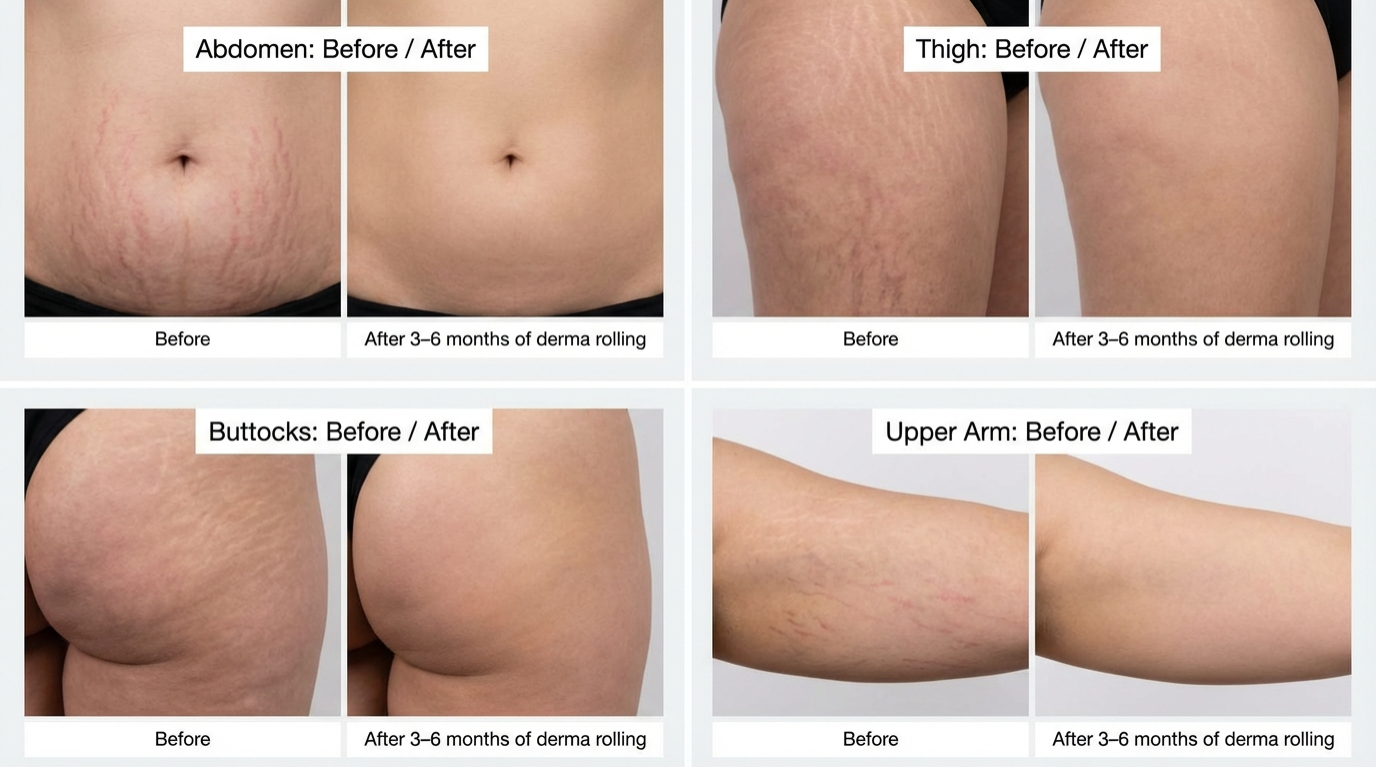
Representative before/after results across common treatment areas. Individual outcomes depend on stretch mark age, depth, and consistency of treatment.
Step-by-Step Treatment Protocol
Unlike facial microneedling where gentle pressure is paramount, body skin for stretch marks requires a slightly more assertive approach. The thicker dermis needs adequate needle penetration to trigger meaningful collagen response. For foundational microneedling principles, refer to our Complete Guide to Microneedling.
- 01Cleanse the area. Wash the treatment area with a gentle cleanser and pat dry. Ensure the skin is free of lotions, oils, and makeup. If the area has body hair, trim it short (do not shave immediately before treatment as this can cause irritation).
- 02Sterilize your derma roller by soaking the roller head in 70% isopropyl alcohol for 5 to 10 minutes. Allow it to air dry on a clean surface. Never share your derma roller with another person.
- 03Optional numbing. For 1.5mm and above, you may apply a topical numbing cream containing 4% lidocaine 30 to 45 minutes before treatment. Wipe it off completely before rolling. This step is optional but helpful for sensitive areas.
- 04Rolling technique. Place the roller on the stretch-marked skin and roll 6 to 8 times in each direction: horizontally, vertically, and diagonally. Use firm, even pressure, noticeably more than you would on the face. Lift the roller between passes rather than dragging it across the skin. You should see uniform pinkness or light pinpoint bleeding, which indicates you have reached the correct depth.
- 05Apply treatment serum right after rolling, while the micro-channels are still open. You have roughly 10 to 15 minutes before they close. Use gentle patting motions rather than rubbing.
- 06Aftercare: Let the area breathe. Wear loose, soft clothing over the treated area for 24 hours. Avoid hot showers, swimming pools, saunas, and direct sun exposure for 48 hours. Do not apply perfumed lotions or body sprays for at least 24 hours post-treatment.
Best Products to Apply After Rolling
The micro-channels created by dermarolling allow topical products to penetrate up to 80% deeper than surface application. Choosing the right serum amplifies your results significantly. See our guide on the best serums to use with a derma roller for complete recommendations.
- 01Hyaluronic Acid is the safest post-rolling option for all skin types. It hydrates deeply, plumps the skin, and supports wound healing without irritation. Apply immediately after rolling.
- 02Rosehip Oil is rich in vitamin A, vitamin C, and essential fatty acids. Clinical studies suggest rosehip oil improves skin elasticity and reduces the appearance of scars. Well tolerated on post-microneedled skin.
- 03Vitamin E Oil is a potent antioxidant that supports collagen synthesis and protects new tissue from oxidative damage. Can be applied directly after rolling or mixed with hyaluronic acid serum.
- 04Vitamin C Serum (10-20%) stimulates collagen production and brightens hyperpigmented stretch marks. Use a gentle, buffered formulation rather than pure ascorbic acid to avoid stinging on freshly rolled skin.
- 05Retinol (use with caution): Retinol accelerates cell turnover and boosts collagen. However, do not apply retinol immediately after rolling with needles above 0.5mm as it can cause severe irritation. Instead, use retinol on non-rolling days as part of your ongoing routine. Avoid retinol entirely on newer red stretch marks as it may worsen inflammation.
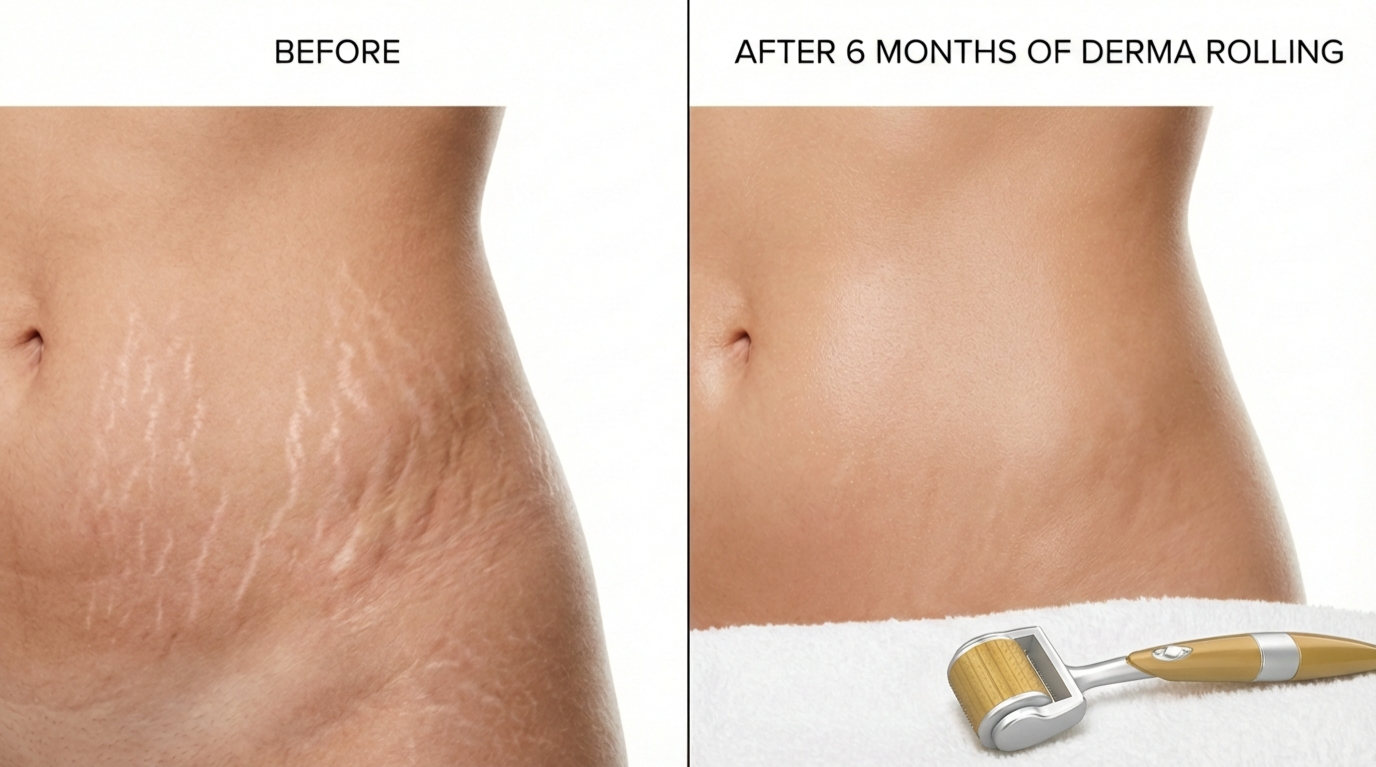
Representative illustration of stretch mark improvement after 6 months of consistent derma rolling. Individual results vary based on stretch mark age, depth, and skin type.
Red vs White Stretch Marks: What to Expect
The age and colour of your stretch marks is the single biggest predictor of treatment success. Understanding the difference helps set realistic expectations.
Red / Purple Marks (Striae Rubrae)
These are newer marks, typically less than 12 months old. They still have active blood supply and intact (though damaged) collagen infrastructure. Response to microneedling is excellent, and many patients see 40 to 60% improvement within 3 to 4 sessions. The existing vascularity accelerates healing and collagen production. Start treatment as early as possible for best results.
White / Silver Marks (Striae Albae)
These are mature marks, typically over 1 to 2 years old. The collagen is fully disorganised and blood vessels have retreated. Treatment is still effective but requires more sessions (6 to 12) and patience. Expect 20 to 40% improvement over 6 to 12 months. The marks may not disappear completely but can become significantly less visible as new collagen fills the depressed areas.
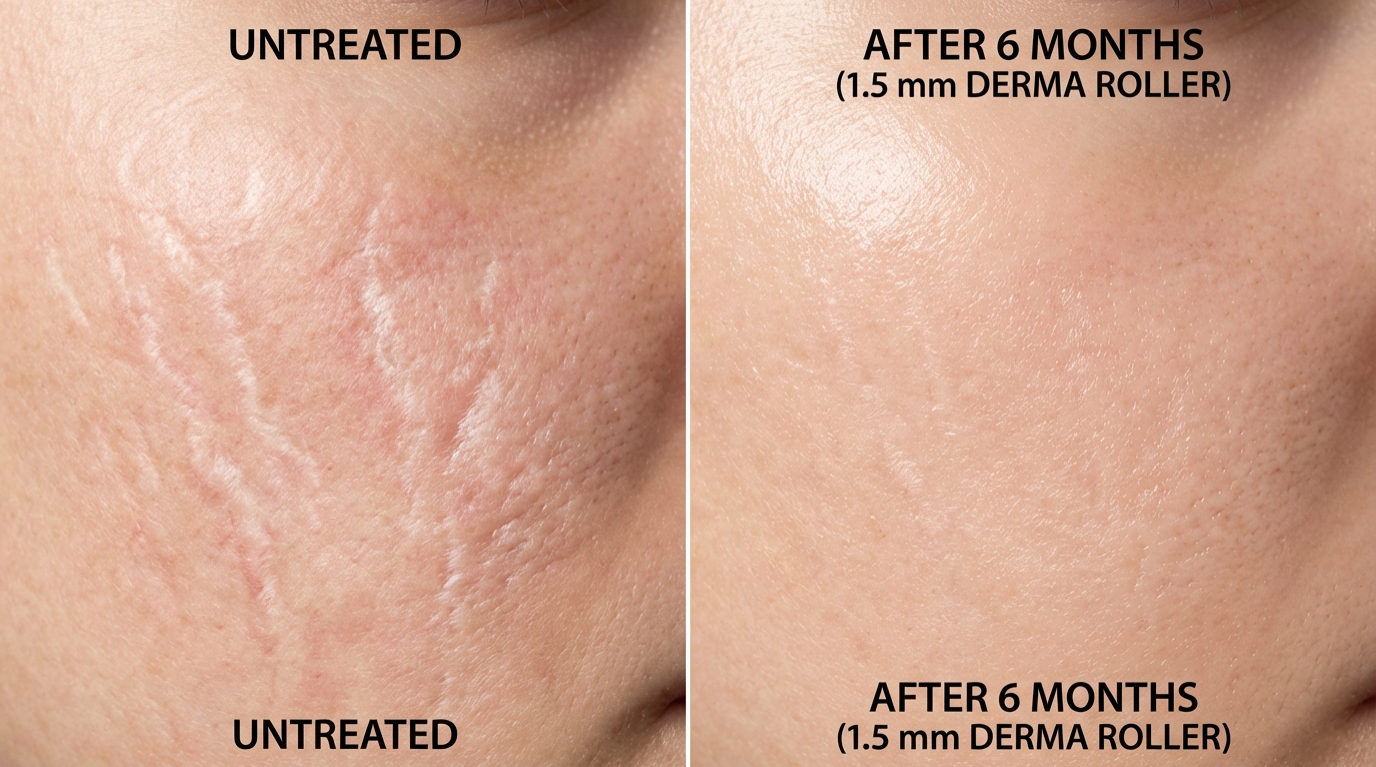
Close-up: untreated stretch marks (left) vs after 6 months of consistent 1.5mm derma roller treatment (right). Results vary by individual.
For Indian skin types (Fitzpatrick IV-V), there is an additional consideration. Stretch marks on darker skin often have a hyperpigmented border that can temporarily darken after microneedling before gradually fading. This is a normal response. Using a vitamin C serum post-treatment and diligent sun protection helps manage this pigmentation response effectively. If you also struggle with darkened skin on your knees or elbows, a similar microneedling approach can help. See our derma roller for dark knees and elbows guide for the full protocol.
Common Misconceptions About Stretch Mark Treatment
Myth: Stretch marks can be completely erased with any treatment.
Reality: No treatment, whether laser, microneedling, or surgery, can fully remove stretch marks. What treatments can do is reduce their depth, width, and colour by 20 to 60%, making them significantly less noticeable. Setting realistic expectations from the start prevents disappointment.
Myth: Cocoa butter or bio-oil can prevent stretch marks during pregnancy.
Reality: No topical product has been proven to prevent stretch marks. They are caused by mechanical rupture of dermal collagen from rapid stretching, combined with hormonal changes. Moisturising helps skin health generally but does not prevent the structural tearing. Treatment after they form is backed by more research.
Myth: Old white stretch marks cannot be improved at all.
Reality: White (striae albae) marks respond more slowly, but they still improve with consistent microneedling. Published trials report 20 to 40% improvement over 6 to 12 months of regular treatment. The key is patience and more sessions compared to newer red marks.
Myth: You need deep 2.0mm+ needles for stretch marks.
Reality: 1.5mm is the best depth for most body stretch marks and is well-supported by research. 2.0mm+ needles significantly increase pain, downtime, and bleeding without proportionally better results. Start at 1.0-1.5mm for the best balance of safety and efficacy.
Realistic Treatment Timeline
Collagen remodeling is a biological process, and no amount of wishful thinking will speed it up (trust us, we get asked about shortcuts all the time). Use our treatment tracker to log your derma rolling sessions and monitor progress over time. Setting realistic expectations prevents discouragement and ensures you continue treatment long enough to see meaningful results.
- Weeks 1-4Skin texture begins to change. The treated area may feel slightly smoother. No visible change in stretch mark appearance yet. This is the inflammatory phase where your body is mobilising healing resources.
- Weeks 6-8First visible improvements. Red stretch marks begin to fade in colour. Some marks feel less indented to the touch. New collagen fibres are being laid down in the treatment zone.
- Months 3-6Significant improvement becomes apparent. Marks look narrower and shallower, with less pigmentation. This is the collagen remodeling phase where fibres reorganise into a more normal pattern. Most people are satisfied with their progress at this stage for newer stretch marks.
- Months 6-12Continued refinement. Older white marks require this extended timeline. The skin continues to remodel and thicken over the scarred areas. Consistency with monthly sessions is essential during this phase.
Derma Roller vs Laser for Stretch Marks
Both microneedling and laser therapy are research-backed treatments for stretch marks. Here is how they compare across the factors that matter most.
Derma Roller (Microneedling)
- Cost: Rs 250-500 one-time purchase
- Efficacy: 20-60% improvement over 3-12 months
- Sessions: Self-administered monthly at home
- Downtime: 24-48 hours mild redness
- Pigmentation risk: Low (safe for darker skin)
- Convenience: Treat anytime at home
Fractional CO2 Laser
- Cost: Rs 5,000-25,000 per session
- Efficacy: 40-70% improvement over 3-6 months
- Sessions: 3-6 clinic visits required
- Downtime: 3-7 days redness and peeling
- Pigmentation risk: Moderate (caution on darker skin)
- Convenience: Requires clinic appointments
For Indian skin types, the lower pigmentation risk with microneedling is a significant advantage. Fractional CO2 lasers can cause post-inflammatory hyperpigmentation in Fitzpatrick IV-V skin, requiring additional treatments to resolve. Many dermatologists in India now recommend starting with microneedling and only escalating to laser therapy if results are insufficient after 6 months. Also, the ability to treat yourself at home monthly means you can maintain a consistent schedule (create a 12-week derma rolling schedule) without clinic visit logistics. For more about how microneedling compares across different skin concerns, see our guide on Derma Roller for Acne Scars.
Important Precautions
Microneedling for stretch marks is generally safe when performed correctly, but certain situations require caution or avoidance.
- 01Do not roll during pregnancy. It may be tempting to treat stretch marks as they form during pregnancy, microneedling should be avoided entirely during this period. The skin is highly sensitive, infection risk is elevated, and many post-rolling serums (especially retinol and high-dose vitamin C) are contraindicated during pregnancy.
- 02Wait 3+ months postpartum. After delivery, give your skin and hormone levels time to stabilise before beginning treatment. If breastfeeding, avoid rolling on or near the breast area and skip retinol-based serums entirely. Consult your doctor before starting treatment.
Editor's Note
Do NOT start microneedling during pregnancy or breastfeeding. Wait at least 3 months after delivery (6 months if breastfeeding) before beginning treatment. Pregnancy stretch marks continue to mature and change colour for several months postpartum, and treating too early means you are working on a moving target. The best time to start is when your stretch marks have stabilised in appearance.
- 03Never roll over broken skin. Active rashes, wounds, sunburn, infections, or inflamed skin should never be microneedled. Wait until the skin has fully healed before treating the area.
- 04Replace your roller regularly. Titanium needles dull with repeated use. A blunt roller tears the skin rather than puncturing it cleanly, causing unnecessary damage and poor results. Replace your ZGTS derma roller after 10 to 15 sessions for 1.0mm and above, or 20 to 25 sessions for smaller sizes.
- 05Keloid-prone individuals: if you have a history of keloid or hypertrophic scarring, consult a dermatologist before microneedling. While rare, there is a theoretical risk of triggering abnormal scarring in keloid-prone skin, particularly with longer needle lengths.
Stop Treatment Immediately
Stop treatment and consult a dermatologist if you notice:
- Signs of infection such as pus, unusual warmth, or spreading redness around treated areas
- Stretch marks becoming darker or more pigmented after treatment (PIH)
- Raised, thickened skin forming at needle sites (early keloid, more common on the chest and shoulders)
- Blistering, severe peeling, or skin breakdown
- No improvement after 6 months of consistent treatment (you may need professional-grade treatment)
Frequently Asked Questions
How many derma roller sessions do I need for stretch marks?
For newer red stretch marks, most people see meaningful improvement after 3 to 4 sessions spaced 4 to 6 weeks apart. Older white marks typically require 6 to 12 sessions over 6 to 12 months. Each session triggers a new round of collagen production, so consistency is more important than intensity. Continue monthly maintenance sessions even after you are satisfied with results to preserve the improvement.
Is microneedling for stretch marks painful?
Microneedling stretch marks is mildly uncomfortable but not unbearable — most people tolerate 1.0-1.5mm needles on body areas without numbing, rating it 3-5 out of 10 on a pain scale. Sensitive zones like inner thighs and breasts benefit from 5% lidocaine cream applied 30-45 minutes before rolling, then wiped off completely. Body skin tolerates depth better than facial skin.
Can I completely remove stretch marks with a derma roller?
No — complete removal is unlikely with any treatment, including laser. Microneedling can reduce stretch mark visibility by 20-60% depending on their age, depth, and your consistency. Newer red marks respond dramatically better than mature white ones. After a full treatment course, marks become narrow, flat, and close to natural skin tone — far less noticeable in daily life.
Can I use a derma roller on stretch marks from pregnancy?
Yes, but not during pregnancy or the immediate postpartum period. Wait at least 3 months after delivery (longer if you had a C-section, wait until the surgical scar is fully healed). Once cleared, pregnancy-related stretch marks on the abdomen respond well to 1.5mm microneedling. Many women begin treatment 4 to 6 months postpartum and see significant improvement within 3 to 6 months of consistent monthly sessions.
Is a derma roller safe for Indian / darker skin tones?
Yes. One of the key advantages of microneedling over laser treatment is its safety profile on Fitzpatrick IV-V (Indian and darker) skin types. Unlike laser, which targets pigment and can cause post-inflammatory hyperpigmentation or hypopigmentation in darker skin, microneedling works mechanically and does not interact with melanin. Some temporary darkening around the treated area may occur but resolves within 1 to 2 weeks. Using a vitamin C serum after rolling and applying sunscreen to sun-exposed treated areas further minimises any pigmentation risk.
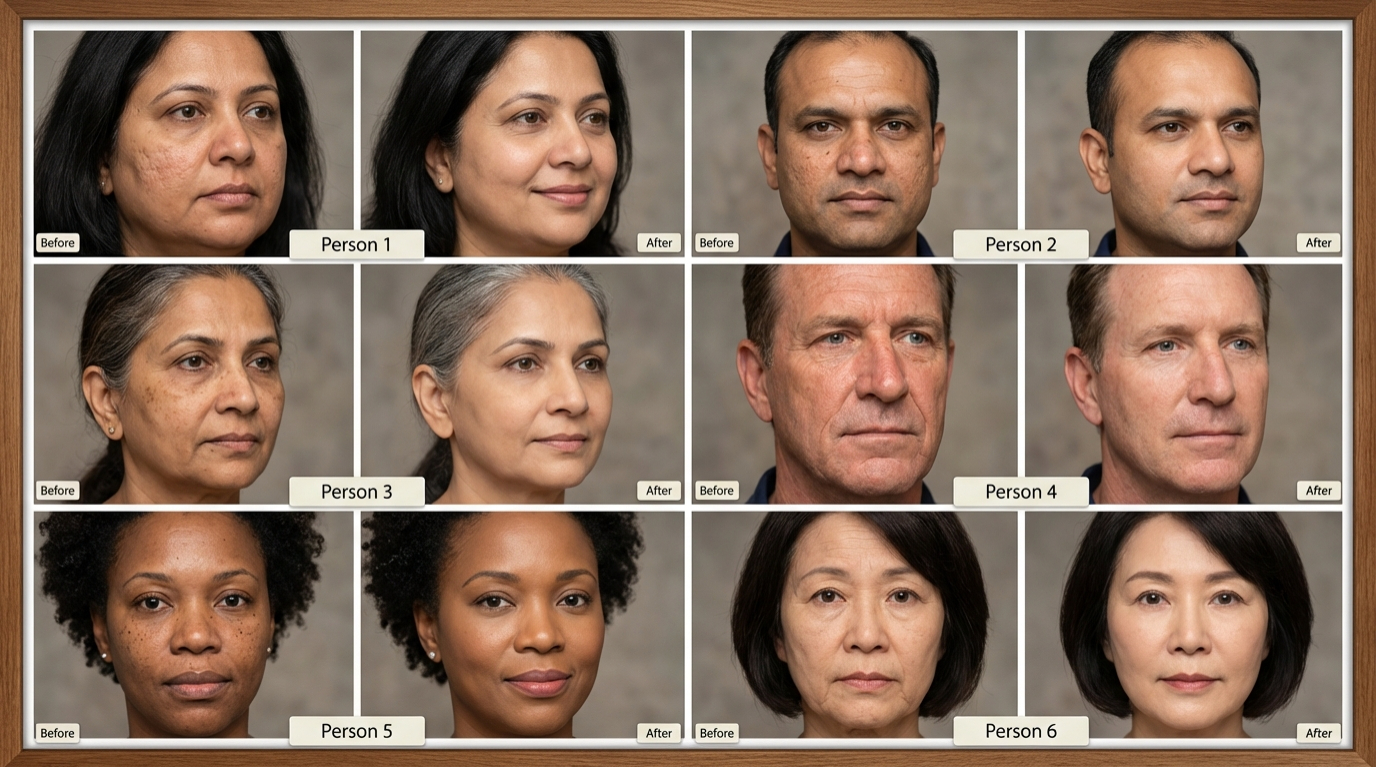
Microneedling works across all skin types. Representative results from diverse Fitzpatrick skin types (II–VI) after consistent derma roller treatment.
When to Stop Googling and See a Dermatologist
At-home dermarolling is effective for many people, but there are situations where professional help is the better path.
- 01You have been treating consistently for 6+ months and see no improvement whatsoever. A dermatologist can assess whether combination treatment (microneedling + PRP or laser) would help.
- 02Your stretch marks are very deep and wide (more than 5mm wide). These severe cases may benefit from clinical-grade devices with deeper penetration.
- 03You are developing new stretch marks rapidly without obvious cause (no pregnancy, weight change, or growth spurt). This could indicate a hormonal condition like Cushing's syndrome and needs medical evaluation.
- 04The emotional impact of stretch marks is affecting your daily wellbeing. A dermatologist can offer faster combination treatments and realistic guidance tailored to your specific case.
Quick Decision Helper
If your stretch marks are new and red/purple (under 12 months old) → Start with 1.0mm roller, every 4 weeks. Apply vitamin C serum after. Expect 40-60% improvement in 3-4 months.
If your stretch marks are old and white/silver → Use 1.5mm roller, every 4-6 weeks. Commit to 6-12 months. Apply hyaluronic acid + vitamin C after each session.
If you are postpartum and want to treat pregnancy stretch marks → Wait at least 3 months after delivery. Start with 1.0mm, graduate to 1.5mm. Avoid retinol if breastfeeding.
If your marks are on sensitive areas (breasts, inner thighs) → Use 1.0mm maximum with gentle pressure. Apply numbing cream if needed.
If you have keloid-prone skin or are currently pregnant → Do not start microneedling without consulting a dermatologist first.
Share Your Experience
Have you used a derma roller for stretch marks? We would love to hear your story: what type of marks you treated, how long it took, and what helped most. Your experience could help someone else take the first step with confidence.
Send your story to hello@zgts.in and we may feature it (anonymously, if you prefer) in a future update of this guide.
How This Article Was Created
This guide was written by the ZGTS editorial team and reviewed for accuracy by Dr. Priya Mehta. It draws on published dermatological research, including studies from the Journal of Cutaneous and Aesthetic Surgery and the Indian Journal of Dermatology comparing microneedling with fractional CO2 laser for striae distensae. We do not invent statistics or cite sources that do not exist. This article is updated periodically and is not a substitute for professional medical advice.
Frequently Asked Questions
Derma Roller for Stretch Marks: Common Questions
Does microneedling work on stretch marks?
On red and purple marks — striae rubrae, the recent ones — yes, and this is where the published results are strongest. Those marks are still vascular and the collagen response has something to work with. On old, white, silvery marks the improvement is real but modest: expect texture and edge softening rather than disappearance.
Can you microneedle stretch marks at home?
Yes, within limits. Home treatment at 1.0-1.5mm on the stomach, thighs or hips is reasonable, at three- to four-week intervals, and expects six to twelve sessions before a fair assessment. What is not reasonable at home is the 2.0mm-plus depth used in clinical courses for old striae — the risk of injury on body skin rises sharply and results do not improve in proportion.
Does microneedling work for stretch marks?
Yes. Multiple clinical trials show 50-70% improvement in stretch mark depth and texture after 4-6 sessions of professional microneedling. At-home derma rolling delivers a milder version of the same result over a longer timeline. Best for early red/purple striae rubrae; less effective on mature white striae albae.
Does derma roller work on stretch marks?
Yes for early/red marks. Partially for mature/white marks. Expect 30-50% improvement in texture and color over 12-24 weeks of weekly rolling. Combine with vitamin C, retinol (on healed skin), or peptide serums for best results.
What is the best derma roller for stretch marks?
1.5-2.0mm needle depth. Smaller needles (0.5-1.0mm) are too shallow to reach the dermal collagen damage. Body skin tolerates deeper rolling than facial skin. Use a 540-needle full-head roller for efficient body coverage and replace every 8-10 sessions.
How often should I derma roll stretch marks?
Every 2-4 weeks at 1.5mm. Every 4-6 weeks at 2.0mm. The body needs longer recovery than the face because deeper rolling causes more dermal trauma. More frequent rolling causes hyperpigmentation, especially on darker skin.
Can derma stamp work for stretch marks?
Yes — and can be more precise for narrow stretch mark zones (hips, breast area). Same 1.5-2.0mm depth. Stamps deliver vertical channels with less skin tearing, reducing post-treatment hyperpigmentation risk. For large areas (full abdomen), a roller covers ground faster.
How long does it take for derma roller to work on stretch marks?
Early color fading at 4-8 weeks. Texture improvement at 12-16 weeks. Maximum gains at 6 months. White/mature stretch marks need longer (4-6 months) and rarely fully resolve at home — in-clinic fractional laser is more effective for those.
Continue Learning
Related ZGTS Guides
Start Treating Your Stretch Marks
The ZGTS 1.5mm derma roller is the most effective at-home tool for body stretch marks. Titanium needles, medical-grade build, and the right depth for collagen remodeling in body skin.
Shop ZGTS 1.5mm on AmazonReferences
- Aust MC, Fernandes D, Kolokythas P, Kaplan HM, Vogt PM. Percutaneous collagen induction therapy: an alternative treatment for scars, wrinkles, and skin laxity. Plastic and Reconstructive Surgery. 2008;121(4):1421–1429. PMID 18349665. doi:10.1097/01.prs.0000304612.72899.02.
- Singh A, Yadav S. Microneedling. StatPearls, NCBI Bookshelf. 2024;NBK459344.
Figures quoted from these sources reflect the study conditions stated in each paper. Results from professional-depth treatment do not transfer directly to shallower at-home use.